We may earn a commission when you buy. Your price stays the same.

Disclosure

Buying guide

Best portable generator for home backup

Read the safety box first. Then pick by watts, runtime, weight and whether the maker lists a carbon monoxide shutoff.

Quick answer

The Champion 201302 is our top pick for home backup through a transfer switch: it lists 9,200 running watts, a CO Shield shutoff, an L14-30R and a 14-50R outlet, and a 3-year warranty. The Champion 201281 is the smaller step down, the DuroMax XP13000EH is the biggest output with a CO shutdown listed, and the Westinghouse units list no CO sensor.

As an Amazon Associate I earn from qualifying purchases. The price you pay does not change. How this works.

Our picks

Best portable generator for home backup. Specs come from the manufacturer pages named in each card. No prices or star ratings are shown.
ProductFuelWattsTankWeightWhere to buy
Champion 201302 9200-watt dual fuel
Top pick, transfer-switch backupChampion 201302 9200-watt dual fuel
Champion Power Equipment
Gasoline and propane9,200 run / 11,500 start (gas)7.7 gal gasoline209 lb
Champion 201281 7500-watt dual fuel
Mid-size dual fuel with CO shutoffChampion 201281 7500-watt dual fuel
Champion Power Equipment
Gasoline and propane7,500 run / 9,375 start (gas)7.7 gal gasoline205 lb
Westinghouse WGen9500DF
Popular, but no CO shutoffWestinghouse WGen9500DF
Westinghouse
Gasoline and propane9,500 run / 12,500 peak (gas)6.6 gal gasoline211 lb dry

As an Amazon Associate I earn from qualifying purchases. Disclosure.

DuroMax XP13000EH
Largest output here, with CO shutoffDuroMax XP13000EH
DuroMax
Gasoline and propane10,500 run / 13,000 peak (gas)8.3 gal gasoline234 lb dry

As an Amazon Associate I earn from qualifying purchases. Disclosure.

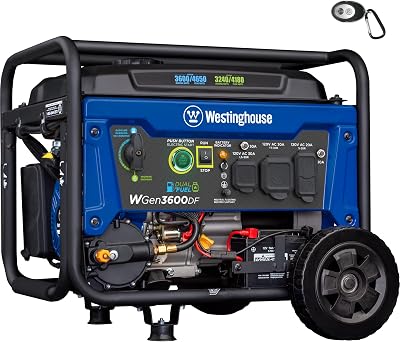
Westinghouse WGen3600DF
Small, essentials onlyWestinghouse WGen3600DF
Westinghouse
Gasoline and propane3,600 run / 4,650 peak (gas)4 gal gasoline120 lb dry

As an Amazon Associate I earn from qualifying purchases. Disclosure.

Figures are the manufacturer's published numbers, or the retailer listing where the cell says so. "Not listed in the sources checked" means we did not find the number, not that it is zero. This site does not print prices because they change; each button opens the retailer.

Buttons open the Amazon product page.

Champion 201302 9200-watt dual fuel

Top pick, transfer-switch backup

Champion 201302 9200-watt dual fuel

Champion Power Equipment

A 9,200 running watt dual-fuel generator with electric start, a built-in CO Shield shutoff, a wheel kit and a 3-year warranty.

Champion lists 9,200 running and 11,500 starting watts on gasoline, 8,280 running and 10,350 starting watts on propane, a 7.7-gallon tank, 10 hours of runtime at 50% load on gasoline (5 hours on propane), 74 dBA, 209 lb and a 3-year warranty. It pairs a CO Shield shutoff with an L14-30R transfer-switch outlet and a 14-50R.

Fuel
Gasoline and propane
Watts
9,200 run / 11,500 start (gas)
Tank
7.7 gal gasoline
Weight
209 lb

Best for: Running a well-planned set of house circuits through a transfer switch, with a carbon monoxide shutoff built in.

What the sources support

  • CO Shield automatic shutoff, per Champion.
  • Outlets listed: L14-30R, 14-50R and two GFCI 5-20R.
  • 3-year limited warranty and a wheel kit, per Champion.

Trade-offs

  • 209 lb per Champion's spec table, even with the wheel kit.
  • 74 dBA at 23 ft per Champion, which is loud at a property line.
  • Dual fuel means storing propane safely and rotating gasoline; the generator does not remove that work.

Demand check: No Amazon sales-rank snapshot taken for this listing.

Sources: Champion 201302 product page

Price changes daily. Open the retailer to see today's price.

Champion 201281 7500-watt dual fuel

Mid-size dual fuel with CO shutoff

Champion 201281 7500-watt dual fuel

Champion Power Equipment

A 7,500 running watt dual-fuel generator with CO Shield, electric start and a 3-year warranty.

Champion lists 7,500 running and 9,375 starting watts on gasoline, 6,750 running and 8,400 starting watts on propane, a 7.7-gallon tank, 10 hours at 50% load on gasoline, 5.5 hours on a 20 lb propane tank, 74 dBA at 23 ft and 205 lb. It is a smaller engine than the 201302, so size it to your circuits and not to the badge.

Fuel
Gasoline and propane
Watts
7,500 run / 9,375 start (gas)
Tank
7.7 gal gasoline
Weight
205 lb

Best for: A smaller whole-home essentials setup (fridge, a few circuits, furnace fan) behind a transfer switch.

What the sources support

  • CO Shield automatic shutoff, per Champion.
  • L5-30R, L14-30R and two GFCI 5-20R outlets listed.
  • 3-year limited warranty with lifetime technical support, per Champion.

Trade-offs

  • 205 lb per Champion.
  • No 14-50R outlet is listed on this model.
  • Propane runtime is 5.5 hours at 50% load on a 20 lb tank, per Champion.

Demand check: No Amazon sales-rank snapshot taken for this listing.

Sources: Champion 201281 product page

Price changes daily. Open the retailer to see today's price.

Westinghouse WGen9500DF

Popular, but no CO shutoff

Westinghouse WGen9500DF

Westinghouse

A 9,500 running watt dual-fuel generator with a 6.6-gallon tank and a 3-year residential warranty.

Westinghouse lists 9,500 running and 12,500 peak watts on gasoline and 8,500 running and 11,200 peak watts on propane, up to 12 hours at 25% load on a 6.6-gallon tank, 74 dBA, 211 lb dry weight and a 3-year residential warranty. Westinghouse's spec table lists no carbon monoxide sensor on this model and CARB compliant: No.

Fuel
Gasoline and propane
Watts
9,500 run / 12,500 peak (gas)
Tank
6.6 gal gasoline
Weight
211 lb dry

Best for: A buyer who wants a 50 A RV outlet and will add a standalone CO alarm and careful placement.

What the sources support

  • Westinghouse lists transfer-switch readiness.
  • Outlets listed: two GFCI 5-20R, an L14-30R and a 14-50R.
  • Westinghouse lists a 3-year residential limited warranty and up to 12 hours at 25% load.

Trade-offs

  • Westinghouse's spec table lists no CO sensor on this model. That is a reason to rank it below the Champions and the DuroMax.
  • Westinghouse lists it as not CARB compliant, which matters if you ever move to California.
  • 211 lb dry weight per Westinghouse.

Demand check: Amazon sales rank snapshot, Nov 20, 2026: #14 in Outdoor Generators.

Sources: Westinghouse WGen9500DF page

Price changes daily. Open the retailer to see today's price.

As an Amazon Associate I earn from qualifying purchases. Disclosure.

DuroMax XP13000EH

Largest output here, with CO shutoff

DuroMax XP13000EH

DuroMax

A 13,000 peak watt dual-fuel generator with a CO sensor shutdown, an 8.3-gallon tank and a 3-year warranty.

DuroMax lists 10,500 running watts on gasoline (13,000 peak) and 9,975 running watts on propane (12,350 peak), 8 hours at 50% load on gasoline from an 8.3-gallon tank, 74 dB, 234 lb dry and a 3-year warranty. DuroMax's spec table lists CO sensor shutdown: Yes. It is the biggest output on this page and the heaviest.

Fuel
Gasoline and propane
Watts
10,500 run / 13,000 peak (gas)
Tank
8.3 gal gasoline
Weight
234 lb dry

Best for: Larger loads or a bigger house, if you accept a very heavy machine.

What the sources support

  • CO sensor shutdown is listed in DuroMax's spec table.
  • 10,500 running watts on gasoline, the highest on this page.
  • 3-year warranty, per DuroMax.

Trade-offs

  • 234 lb dry per DuroMax; plan how to move it.
  • 74 dB per DuroMax.
  • More output means a bigger fuel bill; size it to your actual loads.

Demand check: No Amazon sales-rank snapshot taken for this listing.

Sources: DuroMax XP13000EH product page

Price changes daily. Open the retailer to see today's price.

As an Amazon Associate I earn from qualifying purchases. Disclosure.

Westinghouse WGen3600DF

Small, essentials only

Westinghouse WGen3600DF

Westinghouse

A 3,600 running watt dual-fuel generator with a 4-gallon tank and a 120 lb dry weight.

Westinghouse lists 3,600 running and 4,650 peak watts on gasoline, 3,240 running and 4,180 peak watts on propane, up to 14 hours at 25% load on a 4-gallon tank, 68 dBA, 120 lb dry and a 3-year residential warranty. The spec table lists no CO sensor and CARB compliant: No.

Fuel
Gasoline and propane
Watts
3,600 run / 4,650 peak (gas)
Tank
4 gal gasoline
Weight
120 lb dry

Best for: Running a fridge, lights and a phone charger, not a whole house.

What the sources support

  • Westinghouse lists 68 dBA and 120 lb dry weight, much lighter than the big units here.
  • Up to 14 hours at 25% load on gasoline.
  • 3-year residential limited warranty.

Trade-offs

  • Westinghouse's spec table lists no CO sensor on this model.
  • Not enough for central air or an electric range; read the nameplate watts of what you plan to run.
  • Westinghouse lists it as not CARB compliant.

Demand check: No Amazon sales-rank snapshot taken for this listing.

Sources: Westinghouse WGen3600DF page

Price changes daily. Open the retailer to see today's price.

As an Amazon Associate I earn from qualifying purchases. Disclosure.

How to size a generator

Read the nameplates. Each appliance has a label with running watts or amps. Add up the running watts of everything that will run at the same time, then allow for the starting surge of the biggest motor, such as a well pump, sump pump or air conditioner. We do not publish typical wattage numbers because they vary by model and age.

Pick circuits first, then the generator. A transfer switch lets an electrician power a chosen set of circuits. Ask the electrician to size the switch to your panel, and then pick a generator that covers those circuits. Champion lists an L14-30R and a 14-50R on the 201302; the Westinghouse WGen9500DF lists an L14-30R and a 14-50R and is transfer-switch ready; the Champion 201281 lists an L5-30R and L14-30R.

Match the outlet to the cord. A generator inlet, a transfer switch and a cord must all match. Do not guess the plug type.

What separates these five

CO shutoff. Champion lists CO Shield on the 201302 and 201281. DuroMax lists CO sensor shutdown on the XP13000EH. Westinghouse’s spec tables for the WGen9500DF and WGen3600DF list no CO sensor and list them as not CARB compliant. That is why they rank below the others here.

Output. The DuroMax lists 10,500 running watts on gasoline, the Champion 201302 lists 9,200, the Westinghouse WGen9500DF lists 9,500, the Champion 201281 lists 7,500, and the WGen3600DF lists 3,600.

Weight. The WGen3600DF is 120 lb dry. The big units are 205 to 234 lb. A wheel kit helps, but plan how you will move one over grass or steps. The Champion 201302 lists a wheel kit.

Runtime. Makers publish runtime at a stated load. Champion lists 10 hours at 50% load on gasoline for the 201302 and 201281. Westinghouse lists up to 12 hours at 25% load for the WGen9500DF. DuroMax lists 8 hours at 50% load. Those load percentages differ, so do not compare them directly.

Noise. Champion lists 74 dBA at 23 ft for both Champions, Westinghouse lists 74 dBA for the WGen9500DF and 68 dBA for the WGen3600DF, and DuroMax lists 74 dB.

Dual fuel in practice

All five run on gasoline or propane. Propane stores well and burns cleanly, but the output drops. Our dual-fuel guide compares the gas and propane ratings side by side.

Maintenance you owe it

Run it periodically under load, keep fuel fresh or use propane, and follow the manual for oil. A generator that has not started since last winter is not backup.

Questions people ask

How many watts do I need for home backup?

Add up the running watts on the nameplates of what you want to run, then add allowance for the largest motor's starting surge. Start with essentials: refrigerator, a few lights, furnace blower, a sump pump. Do not size from a brochure.

Can I plug a generator into a wall outlet?

No. Backfeeding can electrocute line workers and neighbors. A qualified electrician installs a transfer switch or interlock; otherwise plug appliances directly into the generator with outdoor-rated cords.

Does a CO shutoff make it safe indoors?

No. The CPSC and the Red Cross say to run portable generators outdoors only and at least 20 ft from the house. A CO shutoff is a backup, not permission to move the generator closer.

How we picked

These picks come from reading each maker's published specifications and the retailer listing behind the button, then noting where the two disagree. We have not run hands-on tests of these products, and we do not show prices or star ratings. A pick is a fit for a job, not a test result. Where a number was not published in the sources we checked, the table says so. Amazon sales-rank notes are dated snapshots, a demand signal and not a quality measure. Some links are affiliate links; see the disclosure at the top of the page and the editorial policy.

Related guides